Drivers know what safe driving looks like. So why do risky habits persist? Read article


Anyone who lives near a state border has likely wondered whether it’s worth driving a few extra miles to save on gas. Conventional wisdom says that when prices are higher on one side of the border than the other, whether due to differences in gas taxes or some other reason, drivers will cross to take advantage of the difference.
But recent analysis from Arity suggests the story is a bit more nuanced: It may be how fast prices are changing, not just how high they are, that most strongly influences cross‑state border fueling behavior.
Here’s why that matters. Mobility data, specifically driving behavior data, can be an early indicator of consumer behavior shifts. This data can reflect consumer decision-making before these patterns show up in missed fuel and c-store sales opportunities.
Arity, a driving intelligence company, has collected over 2 trillion miles of driving behavior data as of the date of this publication. We believe collecting and using data responsibly and transparently can increase road safety and improve business outcomes.
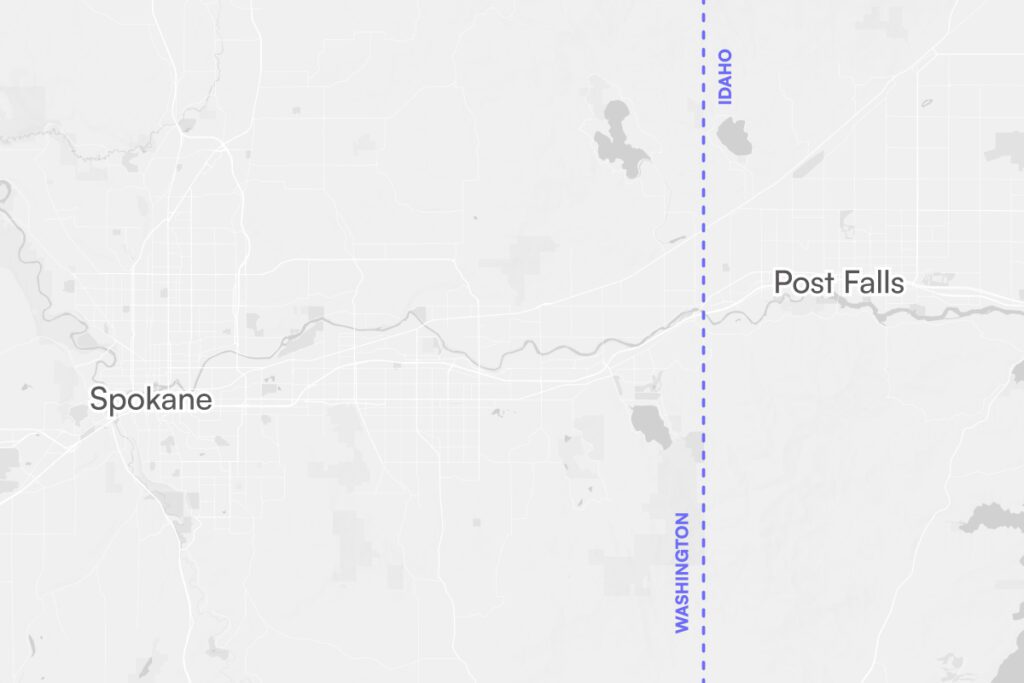
Using insights derived from our aggregated, privacy-forward mobility data, Arity examined gas station visits in the Post Falls, Idaho region, just east of the Washington state line. Specifically, the analysis looked at the share of gas station visits in Post Falls that originated from across the border, and how that share changed over time relative to gas prices in nearby Spokane, Washington.
Two different comparisons produced very different results.
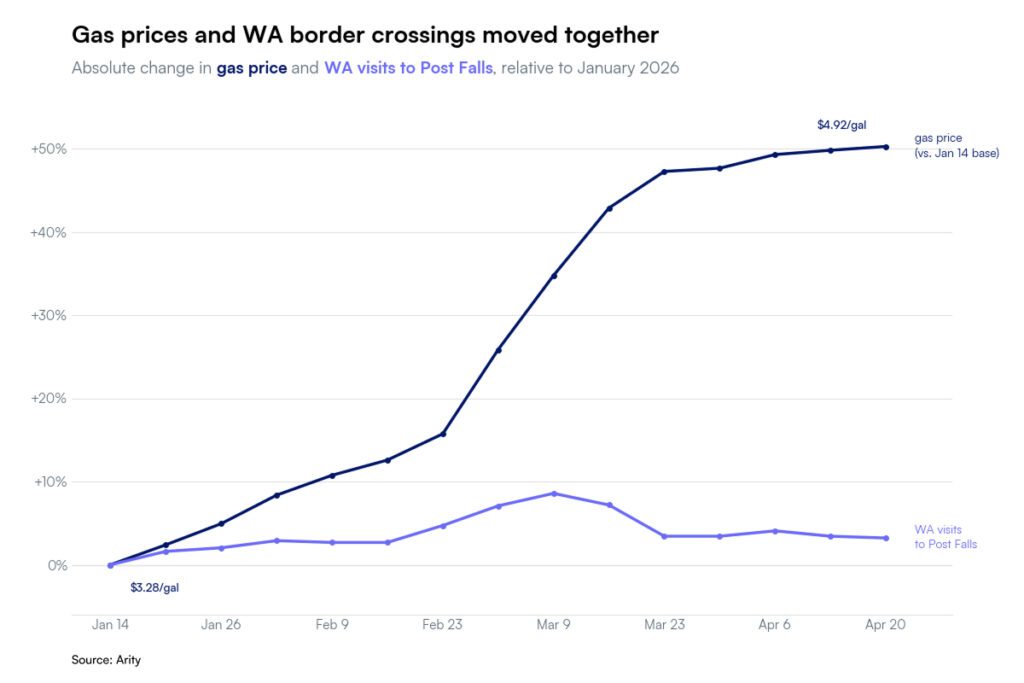
In the first view, Arity compared the 14-day average percentage of visits to gas stations in Post Falls that came from Washington, against the 14-day average gas price in Spokane, a few miles away. At first glance, one might expect a clear relationship: As prices rise in Spokane, more Washington drivers should cross into Idaho to refuel.
But the data tells a more interesting story. While gas prices in Spokane rose steadily over the period, especially in the days and weeks following the start of the Iran conflict on February 28, 2026, the Washington share of visits to Post Falls stations rose only briefly. That share peaked in the first few weeks after the start of the conflict, and then declined again, even as prices remained elevated.
In other words, once prices reached a high but relatively stable level, the cross‑state border effect diminished.
If absolute price levels were the primary driver, the share of Washington-origin visits would be expected to remain high for as long as the price gap persisted. Instead, the behavior appeared to normalize.
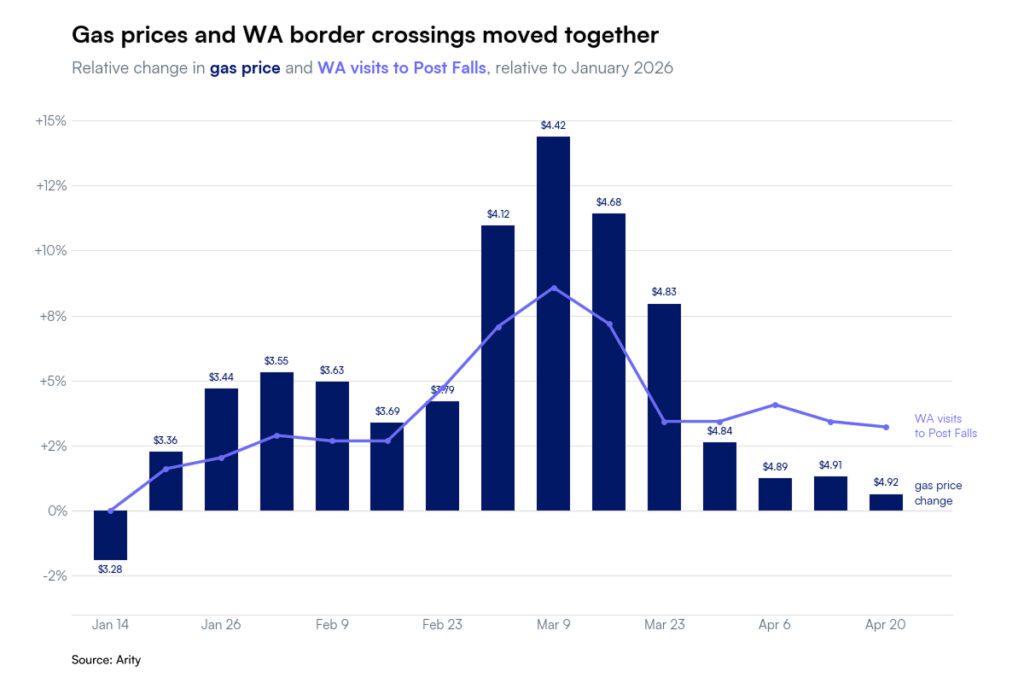
The pattern became much clearer when Arity reframed the analysis. In the second chart, the same 14‑day lagging average visit share was compared not to gas prices themselves, but to the 14‑day rate of change in Spokane gas prices.
Here, the correlation was much stronger. When gas prices in Spokane were rising rapidly following the outbreak of the conflict in Iran, it aligned closely with increases in the share of Washington drivers fueling up in Post Falls. When the pace of price increases flattened, despite the higher price level, the share of cross‑state border visits declined.
This suggests that price shocks, rather than price levels, are what motivate many drivers to change behavior.
Arity’s driving data analysis suggests that consumers are not just trying to minimize costs. They are reacting to sudden change in a profoundly human way.
When gas prices rise quickly, the increase feels visceral. Drivers feel the change immediately: at the pump, in the news, and in their wallets. If cheaper gas is known to exist just across a state border, in this case largely due to different gasoline tax rates between the two states, the perceived payoff of driving a little farther feels worthwhile. People hate losing money more than they value saving or gaining money, so when gas prices go up, they change their behavior to avoid that “loss.”
Over time, however, people adjust to the price shock. Even if prices remain high, the urgency subsides once the rapid price increases slow or stop. The higher price becomes the new normal, and the extra trip across the border begins to feel less compelling. What once felt like a smart response to a sudden shock starts to feel like a hassle.
From this perspective, the data supports a simple but powerful insight: It’s the shock of rapidly rising prices that drives significant shifts in consumer behavior, not merely the height of the price level or the existence of a price gap.
While identifying this behavioral pattern is crucial for gas stations to understand how price hikes may affect behavior, this analysis has implications beyond fuel retailers. It highlights the importance of understanding how consumers respond to rapid change, not just mildly fluctuating conditions.
Whether these shocks come in the form of hikes in fuel costs, expanded shopping districts, changes in highways or bridges, large-scale events, sudden shifts can prompt behavioral responses that may not persist once conditions stabilize.
For planners, retailers, and transportation stakeholders, this distinction matters. Relying solely on price levels to predict consumer behavior may miss nuanced insights that indicate when demand is most elastic: during periods of rapid change.
Of course, gas prices are not the only factor influencing travel and fueling behavior. Seasonal travel patterns, commuting trends, local events, weather, and differences in overall traffic volumes may also play a role. The observed relationship does not rule out these influences.
That said, the contrast between the two analyses – price level versus price momentum – strongly suggests that the rate at which prices move has an ability to explain behavior that’s distinct from the price level itself.
Analyzing mobility data is key to revealing these kinds of consumer insights so that businesses can make the strategic decisions they need to drive their organizations forward.
Arity used its mobility dataset of more than 50 million anonymized active U.S. drivers and focused on the number of drivers who traveled from Spokane, Washington to the Post Falls, Idaho region from January 15, 2026 to April 23, 2026.
Arity tries to publish at least one story every month that highlights how mobility data helps reveal insights that drive business. Got an idea for a story we could write? Submit it here. Arity may not be able to fulfill all data story requests.