How mobility data revealed World Cup group stage visitation patterns and retail trends Read article


Every year, as the spring season slowly arrives, road conditions improve, and overall miles driven once again begin to rise. But this spring also presents some mitigating factors that may interfere with the usual seasonal driving patterns; namely, the war in Iran and the resulting rise in fuel prices.
The last time we faced a significant rise in gas prices, in 2022 at the start of the Ukraine war, a AAA survey noted that 59% of drivers would change their driving habits if the cost of gas rose above $4 per gallon. Will today’s volatile prices reveal a similar belt-tightening response by drivers, and will all drivers experience the same potential disruption in daily habits?
One way to get ahead of this instability: Look to driving behavior data, which may offer early signals of the coming economic impacts before they show up in traditional indicators.
The frequency, depth, and coverage of Arity’s driving behavior data may reveal the early outlines of broader economic pressures related to the rise in gas prices.
Using Arity’s driving behavior data, our data analysts discovered an emerging story about miles driven when viewed through the lens of income levels.
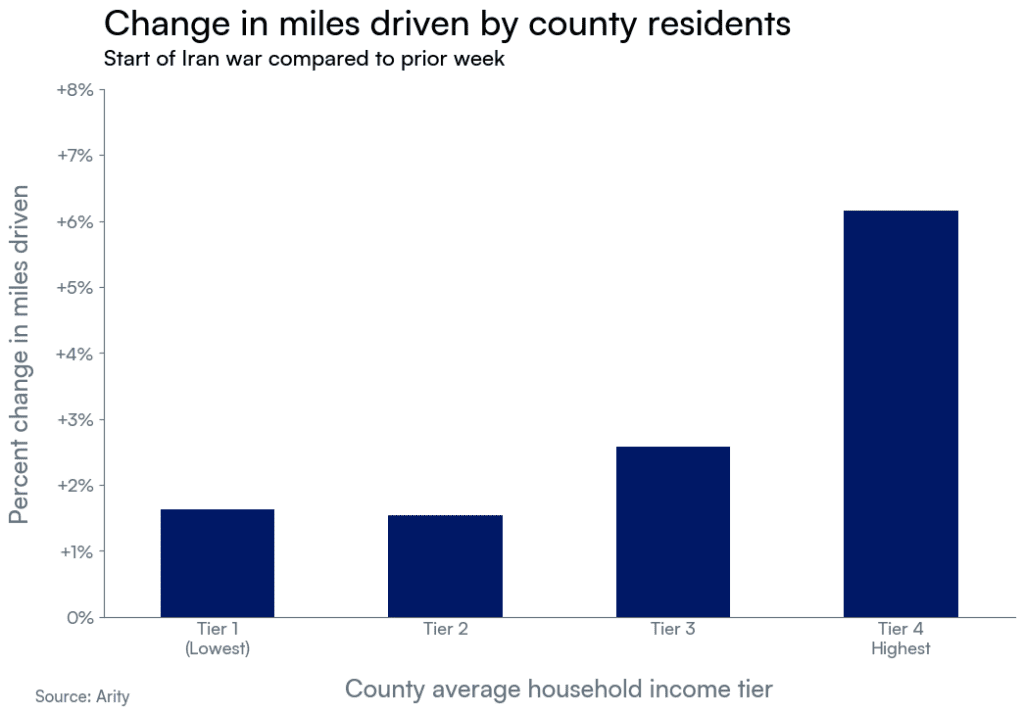
Usually, driving at all income levels increases at similar rates in the spring. However, when looking at our county-level driving behavior data, we found that in the weeks of 2/28/26 – 3/10/26, as gas prices have risen, higher-income communities have continued to drive at typical rates, while drivers originating from lower-income counties are already reducing their miles driven. In fact, counties in the highest income tier continued to increase their miles driven at nearly twice the rate of lower-income communities.
Arity’s data suggests that while gas price increases haven’t yet altered driving behavior for wealthier households, they are already influencing day-to-day mobility decisions for lower-income communities, well before broader economic impacts show up in traditional indicators.
The economic impacts of higher gas prices ripple out into many business sectors. Gaining early insights from driving behavior data can have potential implications for industries such as auto insurance, retail, and finance.
Gaining early insights from driving behavior data can have potential implications for industries such as auto insurance, retail, and finance.
When some cohorts drive less, auto insurers may see lower risk for those populations. Driving at lower speeds also improves gas mileage, so cost-conscious consumers in lower income areas may slow down, further reducing risk in that region. But, as we saw in our driving behavior data during COVID, less congested roads can sometimes lead to speeding, which means a higher risk for those who are still hitting the road.
In addition, disparities between rural drivers, who tend to drive farther, and urban drivers may also become more pronounced: Low-income rural drivers may potentially drive less (or more slowly and efficiently), and urban lower-income drivers may potentially turn to alternative forms of transportation more often.
Insurers will want to understand which scenarios may be unfolding in which of their territories and price accordingly.
With a greater proportion of income going towards higher prices at the pump, consumers – particularly lower-income consumers – will have to compensate in other areas of their budget.
Retailers who have driving behavior data in their toolkit can fine-tune their consumer outreach and foster loyalty with timely, relevant discounts.
Fast-casual restaurants can offer dinner discounts to existing customers who are likely to drive past their establishment and are trying to get all their errands done on the way home from work in one fell swoop.
Auto aftermarket and auto repair retailers can help consumers who are worried about the higher cost of driving by sending promotions for routine maintenance needs – such as tire replacements and pressure checks – that improve mileage.
Convenience stores sending a well-timed price break to a loyalty customer for their favorite products may make it possible for them to maintain their usual purchasing habits.
Investment firms track vehicle miles driven as a signal of economic activity. Declines such as this can indicate reduced consumer spending, raising concerns about companies that rely on high consumer volume. Businesses with a national presence will want to monitor regional variations in driving behavior as well, with a close eye on shifts in rural vs. urban and higher vs. lower-income communities.
As gas prices fluctuate, changes in driving behavior offer an early, real‑world view into how economic pressure is taking shape for businesses and communities. By monitoring these shifts in near real time, businesses can move faster than traditional indicators allow and adjust their strategy before broader impacts fully surface.
Arity tries to publish at least one story every month that highlights how mobility data helps reveal insights that drive business. Got an idea for a story we could write? Submit it here. Arity may not be able to fulfill all data story requests.