Drivers know what safe driving looks like. So why do risky habits persist? Read article


Memorial Day weekend marks the annual start of the summer season, and AAA projects a record 45 million Americans will hit the road. However, it’s not just about how many people drive, but how they drive. Will behaviors and patterns differ from a usual weekday or non-holiday weekend?
Arity analyzed Memorial Day weekend 2025 (May 23 -26) for insights to help this year’s holiday drivers understand the typical behavior trends, avoid the worst travel times, and start summer 2026 fully prepared to beat the traffic.
Three patterns stand out:
Here are more holiday driving insights to help you navigate this year’s long weekend.
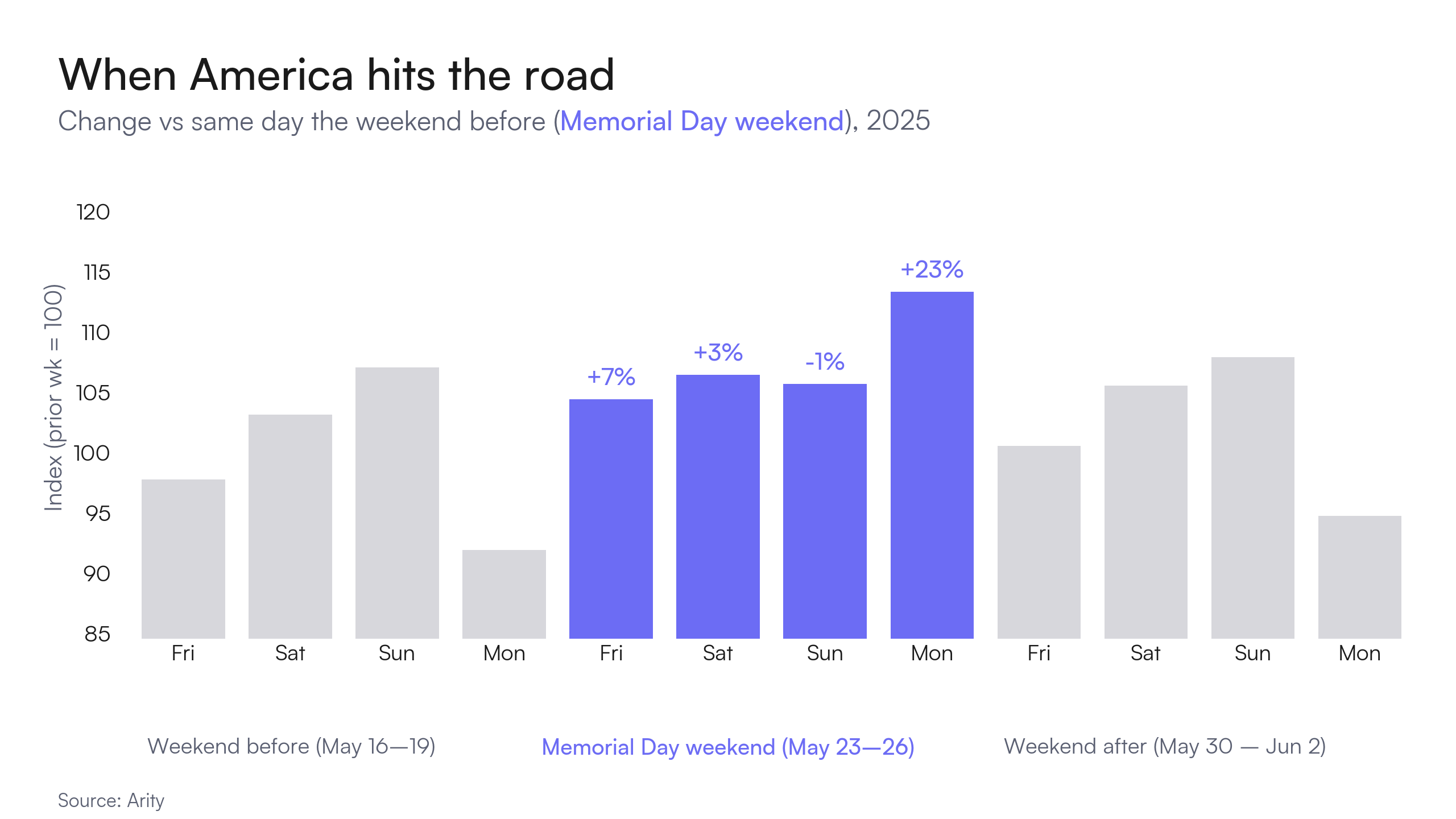
The trends in 2025 remained consistent with previous years, with 4% more miles driven during the holiday weekend compared to the weekend before and after.
Memorial Day Monday saw the biggest lift (+23%) in miles versus a normal weekend, although Friday had the most miles per driver and the fastest speeds of the weekend. This indicates more highway driving and longer distances and follows similar trends from previous years.
Perhaps unsurprisingly, people drove the farthest in three rural states: Wyoming, South Dakota, and Mississippi.
Two of the three states with the lowest miles are also some of the smallest in size: Hawaii, Rhode Island, and New York.
Wyoming and South Dakota top the list again, with New Mexico rounding out the top three.
The three states with the lowest miles are the same as the Friday before: Hawaii, Rhode Island, and New York.
To avoid the heaviest traffic and potentially less safe driving conditions due to speed, wait until late Friday night or Saturday to head to your destination.
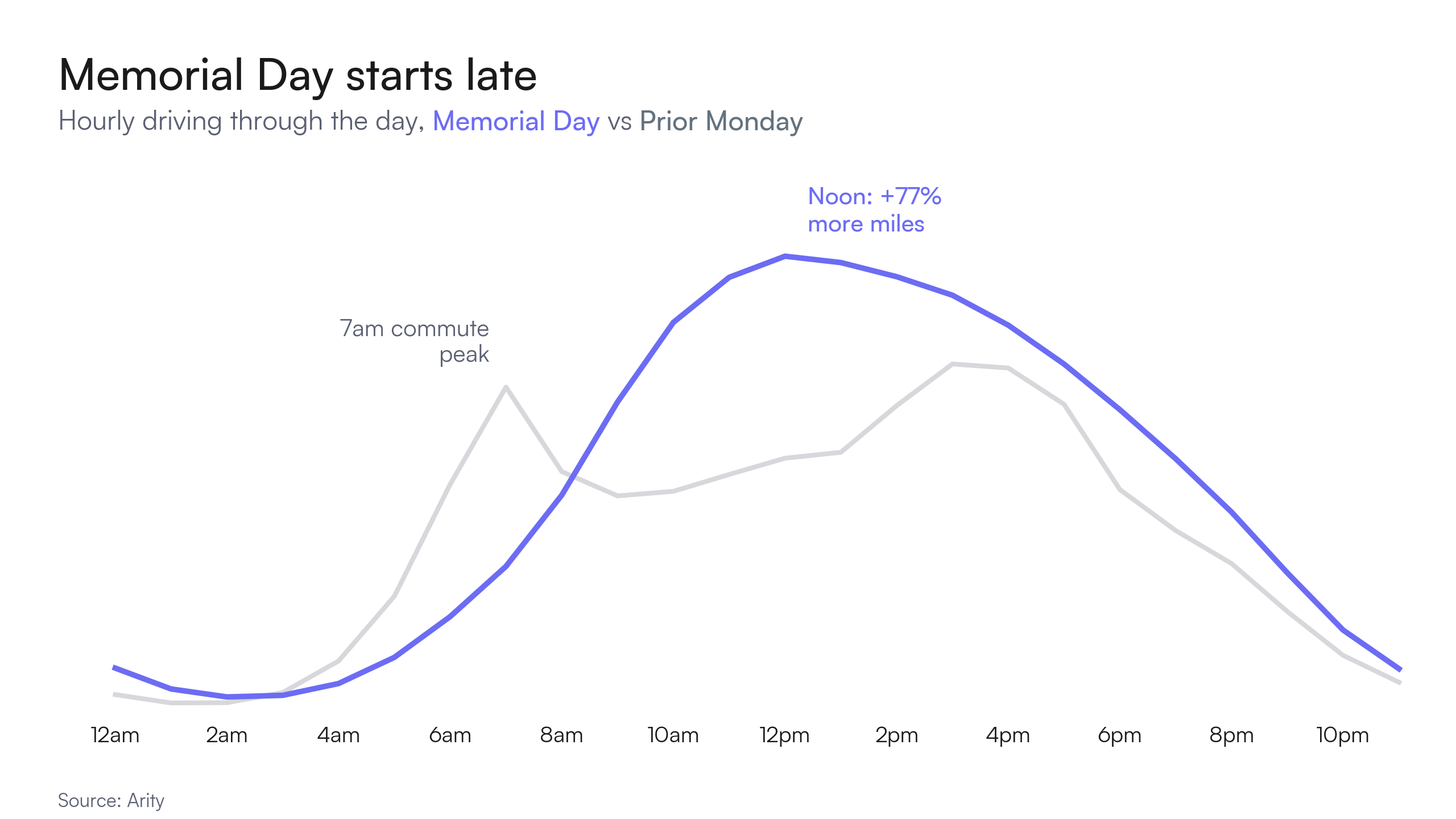
On Memorial Day, the roads were busiest between 10:00 am and 4:00 pm, peaking at noon, with 55% more drivers on the road than at noon the previous Monday.
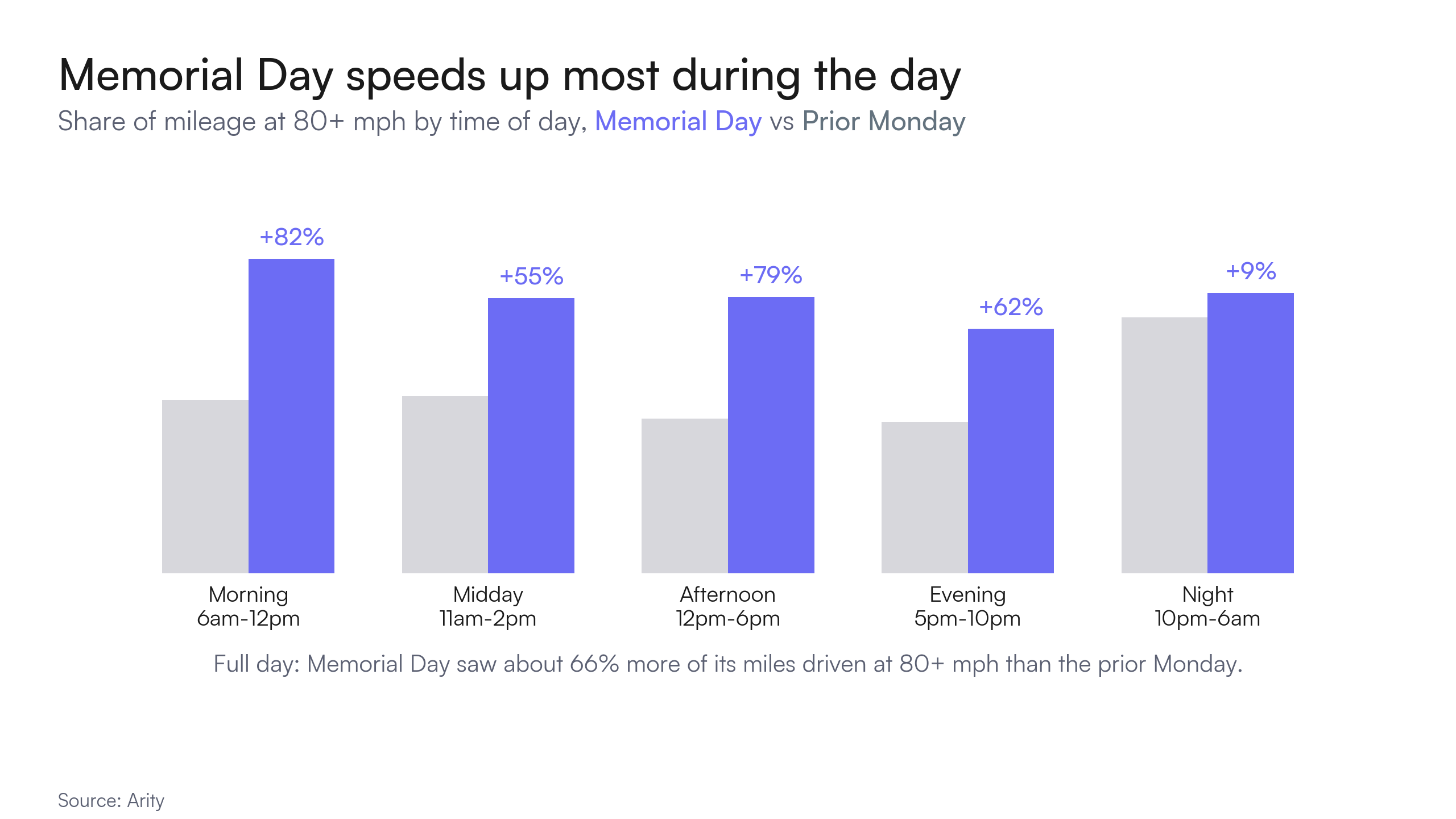
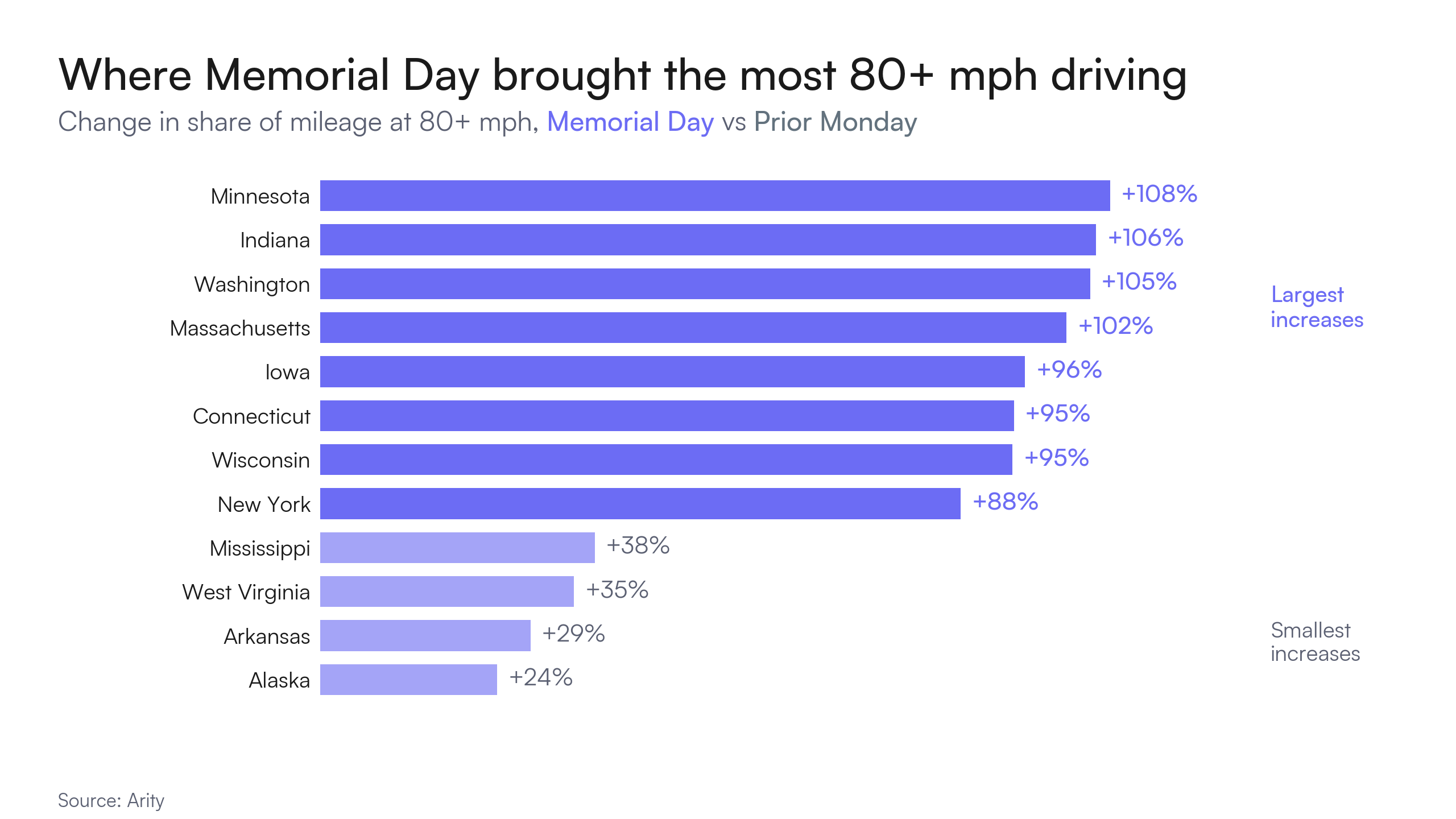
Memorial Day drivers go fast, displaying a 66% increase in high speed (80+ mph) compared to the previous Monday. It’s probable that more drivers are on highways rather than the local roadways of their usual weekday commute. The fact that Monday is a holiday with no commuter traffic likely also contributes to higher speeds.
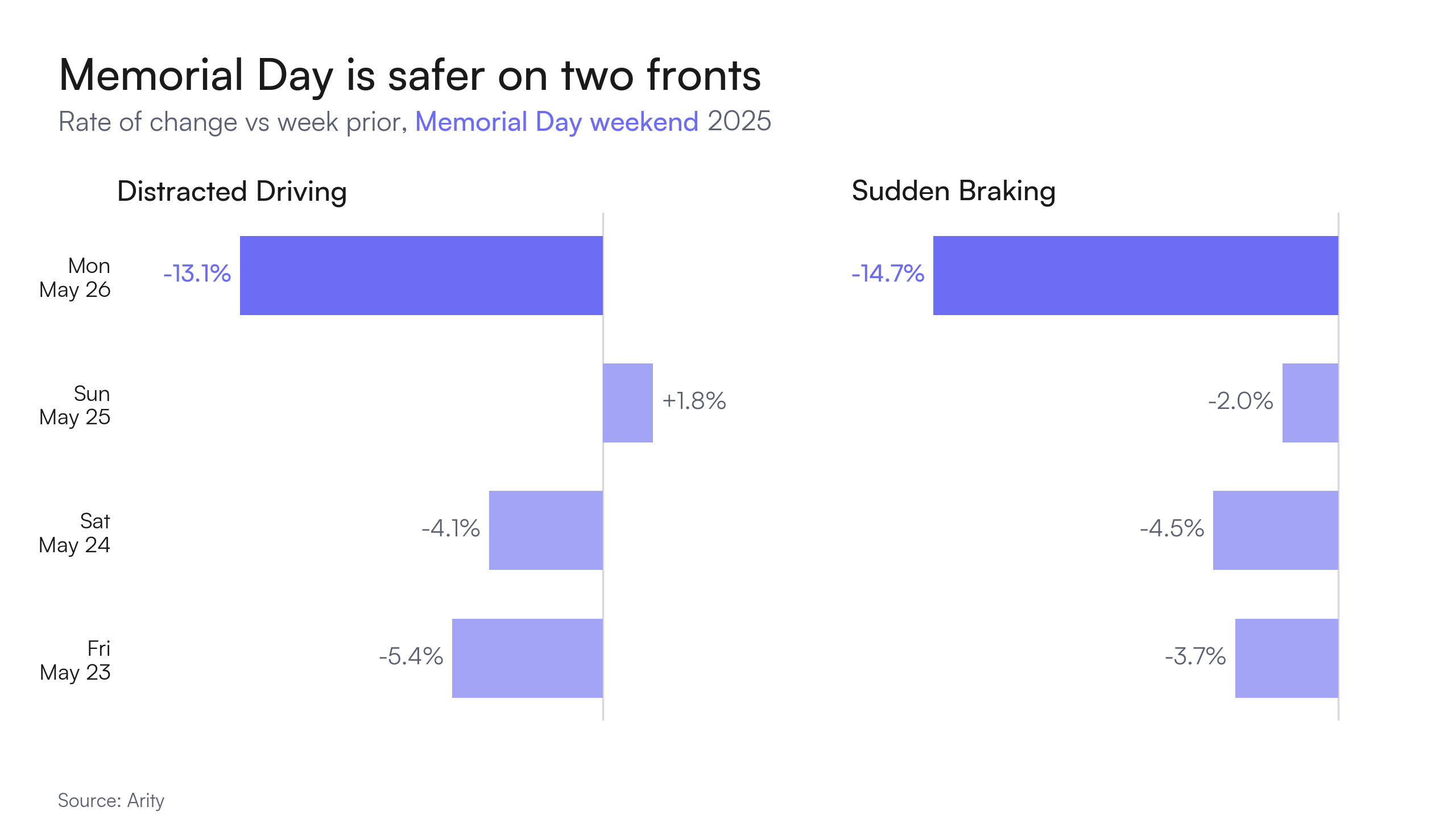
All throughout the holiday weekend, drivers exhibit less distraction and experience fewer hard braking events. Memorial Day itself shows the lowest rates, with distracted driving going down 13%, and hard braking events 15% lower.
With more highway driving, we tend to see less distracted driving and hard braking, as the lack of traffic lights or other signals reduce the everyday commute’s stop-and-start driving experience. Having family members in the car may also encourage lower distraction levels.
The most distracted driving took place on Friday night and Memorial Day afternoon and evening.
Arity defines this as the number of times a phone is unlocked per 1,000 miles driven.
Hawaiians used their phones most frequently, followed by Rhode Island and Massachusetts.
The states with the least amount of distracted driving were Wyoming, New Mexico, and Montana.
Nevada had the largest reduction in sudden braking, followed by North Carolina and New Mexico.
The states with the lowest reduction in sudden braking were Ohio, Alaska, and New York.
The safest time to drive on Memorial Day itself appears to be late at night, when high speeding is relatively low, hard braking and distracted driving rates are at their lowest, and traffic is thin.
Driving behavior data gives businesses unique insights that complement other data types such as foot traffic, demographics, or sales transactions. These insights can support more strategic decisions, faster – accelerating measurable results.
If you know when your customers are most likely to be driving past your business on this holiday weekend, you can connect them with more timely and relevant offers that may be very welcome during a long drive.
Understanding when traffic patterns will change and which driving behaviors are most likely to occur can help municipal officials get ahead of Memorial Day with targeted road safety and traffic interventions.
Arity used its mobility dataset of more than 50 million anonymized active US drivers representing every state and demographic on all types of roads. Our data analysts compare the 2025 Memorial Day weekend with the previous non-holiday week, then review those results year-over-year and at a state level.
Arity tries to publish at least one story every month that highlights how mobility data helps reveal insights that drive business. Got an idea for a story we could write? Submit it here. Arity may not be able to fulfill all data story requests.