Why use mobility data for retail and QSR site selection?
Key takeaways
- Site selection is a long-term capital decision for retail and QSR. Small differences in access, visibility, or traffic flow can materially affect revenue performance over the life of a lease.
- Mobility data adds a more practical view of demand. It shows how people actually move through an area, helping teams validate whether a location fits real consumer behavior.
- For retail and QSR operations leaders, better location intelligence can reduce the risk of underperforming sites. It can improve prioritization across markets, and support more consistent expansion decisions.
- Relying only on static or traditional location inputs creates greater decision risk than in the past. Why? Competition is increasing, and traffic patterns are shifting.
- Mobility data is not just a one-time research tool. Retail and QSR leaders should view mobility data as an input for both upfront site evaluation and ongoing portfolio optimization.
Introduction
Location intelligence is everything for retail and quick-service restaurant (QSR) site selection. Two sites in the same neighborhood can produce dramatically different outcomes depending on how customers move through the area and how easily they can access a location.
For example, while a high-visibility corner with a traffic light and easy access may generate around $2 million in annual revenue, a similar site just a short distance away with poor egress may struggle to reach $800,000. The brands, menus, and prices may be on par with one another, but the ability to capture traffic and customers’ attention is not.
When it comes to site selection, identifying locations within your budget is just the beginning. It’s also about homing in on the best space, as determined by variables such as traffic patterns, visibility, and whether customers can easily enter and exit during peak hours. Failing to assess a prospective site using these factors can result in a location that looks promising on paper but may end up costing you.
Why mobility data is essential for retail and QSR site selection

To evaluate a site’s potential effectively and fully, you need a clear understanding of how consumers behave in the real world. Mobility data provides another key input, helping you make more informed investment decisions and scale those insights across multiple locations over time.
Arity’s mobility data, also known as driving behavior data, is deidentified and collected from mobile applications and connected vehicles where users have opted in to share their data. When aggregated, this data reveals real-world movement and suggests where true demand lies. This consumer intelligence helps operations leaders understand how consumers interact with areas that contain specific prospective sites, offering a clearer predication of customer behavior than traditional location intelligence alone.
How mobility data leads to smarter site selection
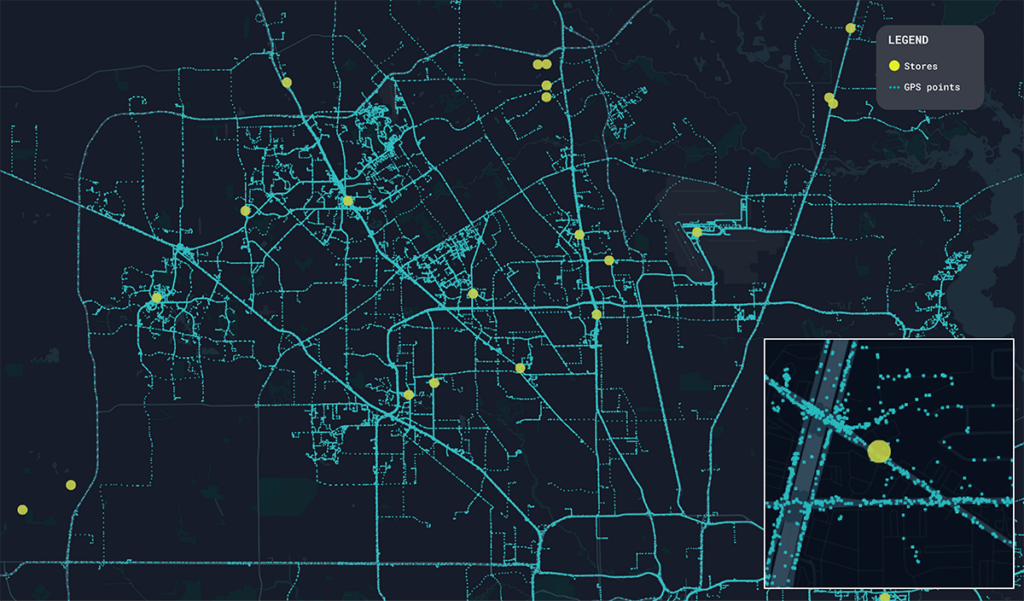
With mobility data as a component, operators can evaluate:
- Traffic flow during different times of day
- Ingress and egress patterns during peak periods
- Common commuter routes and trip paths
- Short visits such as drive-thru stops
- Repeat visitation behavior that signals consistent demand
- Whether passing traffic can realistically access a location
- Overall trade area mapping
These insights help operators assess whether a site location aligns with the intended store format and expected throughput.
Turn mobility data into stronger strategic decisions
Mobility data helps you pressure-test investment decisions before committing capital to a site. Rather than relying on surface-level traffic activity, you can evaluate whether a location can support sustained demand and operational efficiency.
This data can help you answer the following questions:
- Do traffic patterns support repeat visits?
- Can customers easily access the location during peak hours (heavy traffic, turn restrictions, or limited entry points)?
- Does the planned format (such as a drive-thru) match local behavior patterns?
This level of visibility reduces the risk of investing in locations that appear attractive on paper but struggle to convert traffic into revenue.
Use mobility data to evaluate trade areas
Mobility data gives you a clearer view of consumer behavior, which is critical for understanding how demand actually forms around a site. It also helps explain where that demand comes from and how it may change over time, allowing you to plan for both steady traffic and seasonal shifts.
Mobility data can help you answer the following questions:
- Which specific routes generate the most consistent traffic?
- How do nearby competitors influence visitation patterns?
- Where do customers originate from, such as nearby shopping areas or commuter corridors?
- How do traffic conditions shift throughout the day and during peak commuting times?
This creates a more accurate understanding of trade areas and allows you to compare locations based on their ability to capture real demand, not just proximity or volume.
Scale insight across locations and over time
Mobility data extends beyond a single site decision. It gives you a consistent framework for evaluating markets, prioritizing development, and tracking changes in demand.
You can use mobility insights to:
- Evaluate multiple sites using consistent criteria
- Prioritize locations with the strongest long-term potential
- Monitor evolving traffic patterns after development
- Adapt site and operational strategies as customer behavior changes
This makes mobility data an ongoing strategic asset that supports both expansion planning and long-term performance optimization.
What’s at stake: The cost of getting site selection wrong
The financial commitment behind each retail or QSR location is substantial. A typical buildout ranges from six figures to seven figures depending on the market and store format, while ground-up construction for a QSR with a drive-thru can reach $2.5 to $3 million. QSR operators also typically commit to 10-year leases with two 5-year renewal options, turning each site into a long-term investment.
Once that decision is made, there is little opportunity to course correct. A poor initial real estate choice can lock operators into years of underperformance, making it difficult to recover the initial investment or reposition the location.
These outcomes are often driven by small differences in site conditions. For example:
- Will drivers see your business from the road?
- Can drivers easily enter and exit, even at peak hours?
- Is there ample enough parking?
- Is this site part of an established trade area with existing customer traffic?
- Can delivery drivers easily enter and exit, load and unload?
When any of these traffic factors create friction, even a strong brand can struggle to capture demand.
Over time, the impact of site selection decisions compounds. Brands with disciplined site selection strategies tend to grow more profitably, while operators that prioritize expansion cost-savings or speed over location quality may see weaker store performance across their portfolio.
For this reason, real estate site selection decisions require the same level of rigor as menu strategy, staffing, and supply chain planning because they directly shape long-term revenue potential.
Get the insights you need with mobility data
Site selection has always shaped retail and QSR performance, but relying on assumptions based on census data or outdated traffic models is becoming increasingly risky. Consumer routines are shifting faster, competition is denser, and small differences in access or visibility can have an outsized impact on long-term revenue.
Mobility data gives operators a clear view of how people actually move through the real world — where demand exists, when customers are most likely to stop and which locations fit naturally into daily routines.
In a market where margins for error are shrinking, that visibility is becoming essential for making data-driven, vetted site investment decisions.