Arity Lead Platform: The foundation for connected customer acquisition for insurance Read article


When a new grocery store opens, it doesn’t just add incremental traffic; it redistributes remaining demand across the local market.
Historically, it has taken months to fully understand those ripple effects through sales reports, customer surveys, or consumer panel data. But with mobility data, those shifts become visible almost immediately.
A recent example from Bainbridge Township, Ohio provides a clear illustration of this phenomenon.
On May 6, 2026, a new Meijer store opened in the Bainbridge Township area. Using Arity’s mobility data from our Road Traffic Analytics product — which observes real-world visits to specific points of interest — we analyzed how nearby competitors were affected in the days that followed.
To measure impact, we compared each store’s seven-day rolling average visits against a five-week pre-opening baseline (April 1 – May 5, 2026). The results were both clear and immediate:
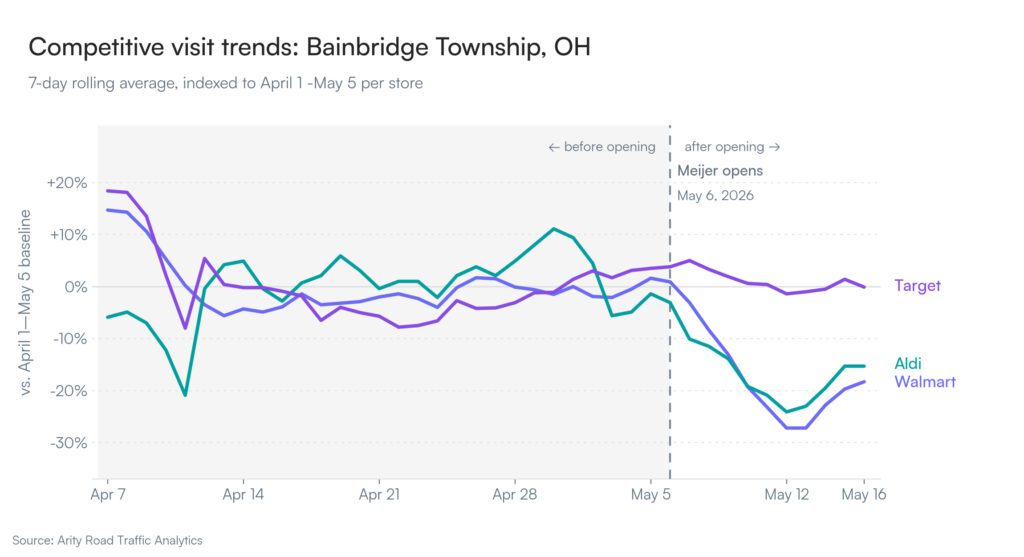
This pattern highlights several important dynamics in the grocery landscape:
Even if some reversion occurs, a short-term decline of more than 20% is operationally significant — and it’s important to understand it quickly.
Arity’s mobility data makes consumer demand shifts visible effectively overnight, helping businesses respond faster and with greater confidence.
Retailers have traditionally relied on lagging indicators such as sales reports, loyalty data, or surveys. They are useful but often take weeks or months to reveal clear trends.
Arity’s mobility data delivers consumer intelligence on a much faster timeline. By measuring observed visits at a daily level, it provides speed, precision, and direct visibility into real-world behavior.
In the Bainbridge Township example, the competitive impact of Meijer’s opening was visible almost immediately — well before traditional data sources would have surfaced a signal.
With mobility data, retailers and investors can monitor the real-time impact of events such as new store openings, identify which competitors are most vulnerable, distinguish between short-term disruption and sustained share shifts, and adjust strategies accordingly.
In this case, Walmart and Aldi appear to be absorbing the initial impact, while Target remains more insulated — an insight that can inform pricing, promotions, and positioning decisions for the retailers that are most affected.
Arity’s mobility data makes consumer demand shifts visible effectively overnight, helping businesses respond faster and with greater confidence. In Bainbridge Township, within days of Meijer opening, the local grocery landscape had already changed — underscoring both the speed of competitive effects and the value of timely insight.
New retail entrants don’t just grow the market — they reshape it. The key question isn’t whether there will be an impact, but how quickly you can understand it and adapt to it.
Using our Road Traffic Analytics product, Arity analyzed its mobility dataset, comparing each store’s seven-day rolling average visits against a five-week pre-opening baseline (April 1 – May 5, 2026). This approach smoothed day-to-day volatility while still capturing rapid behavioral changes.
Companies referenced in these marketing materials are not affiliated with, associated with, or connected to Arity in any way. Such companies were not involved in the preparation of these materials, and any references to such companies do not imply their endorsement, sponsorship, or approval of any kind.
Arity tries to publish at least one story every month that highlights how mobility data helps reveal insights that drive business. Got an idea for a story we could write? Submit it here. Arity may not be able to fulfill all data story requests.