Mobility data myths: What it can and can’t tell you
Key takeaways
- Mobility data is about behavior, not just location. Driving behavior data explains how and why people move — not just where they go.
- Customer journeys are shaped by routines, not touchpoints. Understanding movement over time reveals intent that isolated visits or clicks miss.
- Driving behavior data turns movement into consumer intelligence. Routes and routines clarify preference, predictability, and choice.
- Context makes journeys actionable. Connecting moments into journeys enables earlier, more confident decisions.
- Mobility data works best alongside your existing dataset. Foot traffic data shows moments; mobility explains how those moments connect and what they mean.
- Trust is foundational. Driving behavior insights depend on opt‑in, anonymized, and privacy‑safe data practices.
Introduction
Businesses today don’t need more dashboards. They need signals they can act on before outcomes show up in lagging metrics. That means moving beyond online actions customer behavior (e.g., visits, clicks, or transactions) to an approach that combines digital actions with real-world timing and movement.
Mobility data can reveal insights about how customers move in the real world, including typical routes and routines. By showing how touchpoints connect, organizations can gain context, which can help them discover patterns, predict behavior, and act proactively rather than reactively.
It’s no wonder that driving behavior-based mobility data remains underutilized; businesses often misunderstand it or fail to see how it can be relevant to them. We’ll explore and dispel six common myths.
Myth 1: Isn’t mobility data only useful for auto insurance?
Reality: Mobility data creates behavioral context that applies far beyond any single industry.
Although mobility data is rooted in insurance, its value extends far beyond that space: revealing how people move through the physical world. Any organization that relies on understanding customer movement can benefit from this data.
Mobility data enables businesses and organizations to:
- Align staffing and inventory: Understand actual demand patterns before they appear in sales data
- Optimize operations: Identify shifting trade areas or emerging high-traffic locations and routes
- Improve the customer experience: Reduce friction such as long wait times or traffic congestion
Teams can see emerging patterns before they appear in outcomes like sales or conversions. That early signal allows businesses to move from reactive adjustments to proactive decision‑making.
For instance, a retail chain preparing for the holiday season might use mobility data to identify areas where new roadways, increased commuter traffic, or nearby attractions are likely to drive higher demand. Instead of waiting for sales data to reveal gaps after the fact, the business can proactively adjust staffing and inventory to meet demand in real time.
Teams can see emerging patterns before they appear in outcomes like sales or conversions. That early signal allows businesses to move from reactive adjustments to proactive decision‑making.
Myth 2: Doesn’t mobility data only show where people go?
Reality: Mobility data shows how movement unfolds over time — and what that movement means.
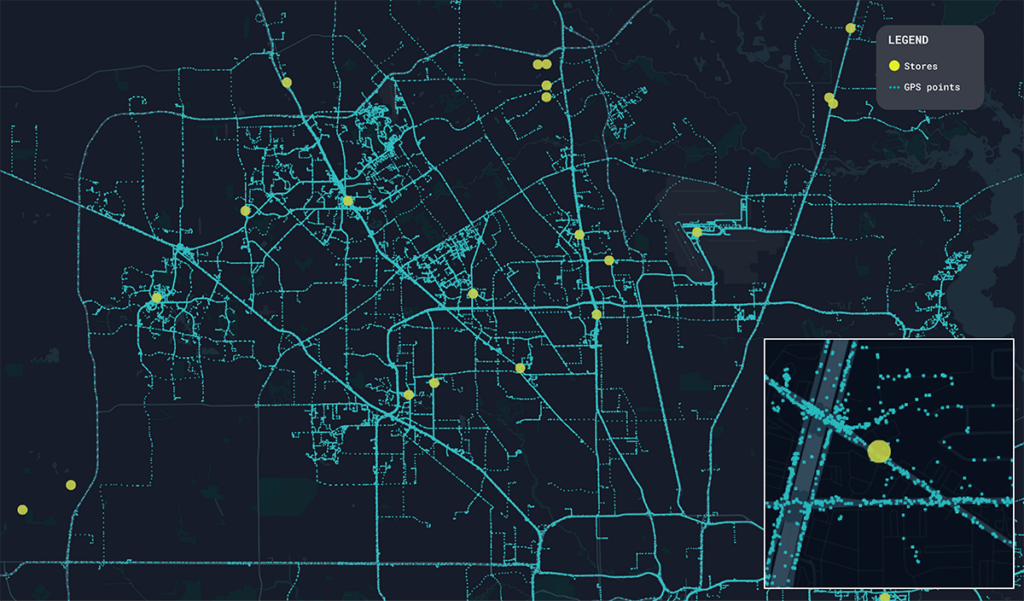
Above: Arity data of trips taken in one week around the retailer’s locations, noted in yellow. Teal indicates drivers that passed but did not stop at locations.
Traditional location data captures presence. Driving behavior mobility data captures patterns.
By observing routes, timing, and frequency, mobility data reveals daily routines and repeat behaviors that single visits cannot explain. Those patterns often signal intent much more clearly than a one‑time stop.
Mobility data can drive efficiency by enabling businesses to:
- Understand daily routes and routines
- Identify peak travel times
- Recognize repeat driving patterns and predictability
- Identify high-intent visits by analyzing which groups of drivers consistently pass by or stop near a location
Consider drivers who follow the same morning route every weekday and consistently stop at the same coffee chain. Over time, that behavior reflects routine, not coincidence. Understanding that distinction would help this chain understand that this cohort is primed for upselling breakfast items.
This is how mobility data turns location into context — and context into consumer intelligence.
Myth 3: Does mobility data replace other forms of location data?
The reality: Mobility data complements, rather than replaces, your existing dataset.
Each type of data plays a distinct role. Location data captures moments — where and when a visit occurred. Foot traffic data can indicate where people moved within a specific location such as a store. Mobility data explains how those moments connect and why they matter. Together, these datasets provide a more complete understanding of customer behavior and decision-making.
For example, location data may show steady visitation at a site, suggesting healthy engagement. Mobility data can add critical context — such as whether customers consistently visit a competitor immediately afterward. That sequence reveals competitive pressure that visit counts alone cannot surface.
Mobility data doesn’t replace location or foot traffic data. It gives it meaning.
Myth 4: Does mobility data show where people visit – but not where they’re going?
Reality: Mobility data helps make behavior predictable.
People tend to follow consistent routines. They follow daily commuting routes, do the same weekend errands, and make habitual stops. By identifying these patterns, businesses can move from reactive reporting to predictive insight.
For example, during the retail holiday season, a QSR can use mobility data to understand when and where holiday shoppers are likely to travel. Using those insights, the QSR can anticipate demand and position offers at the right place and time, capturing customer attention before decisions are made.
Myth 5: Does mobility data identify specific individuals?
The reality: Mobility data is aggregated, anonymized, and privacy-safe.
Driving behavior mobility data is not intended to identify individuals. It is analyzed at scale to reveal trends, routines, and movement patterns without exposing personally identifiable information.
For example, a business might analyze how many drivers pass near a location during certain times of day and which routes are most common. The insight comes from the pattern itself — not from knowing who any specific driver is.
Responsible mobility data use depends on clear consent, aggregation, and transparency. Trust is not optional, it is foundational.
Myth 6: Is mobility data only useful for visit-based businesses?
Reality: Mobility data is valuable wherever real-world behavior influences outcomes.
Any organization affected by how, when, and where people move can benefit from driving behavior insight. Mobility data helps teams understand exposure, timing, and routine—inputs that shape everything from experience design to program effectiveness.
That includes:
- Retail and dining: CPG, QSR, and c-store brands can use mobility data to capture patterns that can inform consumer insights, marketing and advertising, and operations optimization.
- Mobile apps: Mobility data enables teams to measure whether campaigns lead to physical visits or in-person conversions. This allows developers to optimize for real-world impact, not just clicks or digital engagement.
- Connected safety and smart home brands: Mobility data can power features like crash detection, emergency alerts, and connected home responses. By identifying collisions, these systems can trigger notifications to family members or smart home devices — improving safety, awareness, and real-time responsiveness.
Whether the goal is improving engagement, refining outreach, or justifying growth initiatives, movement provides context that purely digital signals cannot.
The common thread isn’t industry. It’s behavior.
Moving beyond mobility data myths
Businesses misunderstand mobility data at their own risk. When organizations move past these myths, they unlock a clearer view of how real‑world behavior shapes decisions.
Driving behavior mobility data helps connect isolated moments into meaningful journeys—revealing not just where customers go, but how and why they move. That understanding turns movement into consumer intelligence, and consumer intelligence into better decisions across programs, acquisition, experience, and measurement.
As the need for earlier, more reliable signals grows, journey‑based insight will continue to matter. Businesses that understand movement — not just outcomes — will be better positioned to act with clarity and confidence.
Learn how mobility data can help you better understand real‑world behavior.