From mobility data to action: Lessons from Arity Insights 2026 Read article

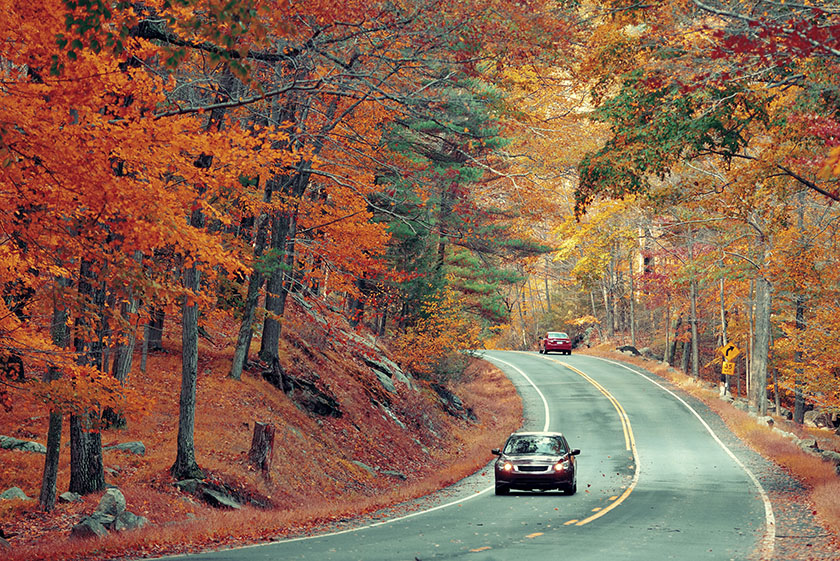
We all know the rhythm of Thanksgiving weekend. We pack the car on Wednesday, drive a few hundred miles to see family, make one frantic trip to the grocery store, eat too much on Thursday, hit the Black Friday sales, and join everyone else on the highway home Sunday.
But what if what we think we know about Thanksgiving driving doesn’t tell the whole story?
We at Arity analyzed our aggregated mobility data observed from November 21 through December 1, 2025. Some commonly held Thanksgiving patterns showed up clearly. Others were more complicated. Taken together, the observed driving activity suggests that Thanksgiving is less a two-day migration than a weeklong shift in how Americans move.
The biggest takeaway: Thanksgiving travel builds gradually, peaks in different ways on Wednesday and Sunday, and changes not only how much people drive but the kinds of trips they make.
Verdict: Half true.
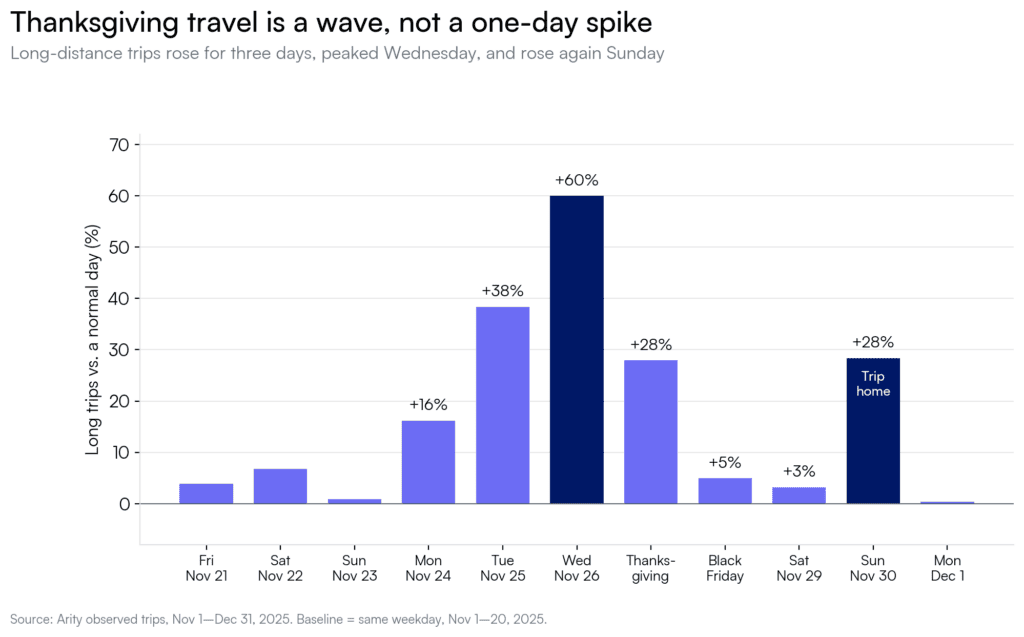
Wednesday is an unusually important departure day. Compared with non-holiday Wednesdays earlier in November, Arity observed about 60% more trips longer than 50 miles on the day before Thanksgiving.
But not all Thanksgiving holiday drivers waited until Wednesday. The holiday pattern began emerging during the preceding weekend. By Monday, trips longer than 50 miles were already running about 16% above baseline. By Tuesday, that number was 38%.
Wednesday was not the beginning. It was the zenith.
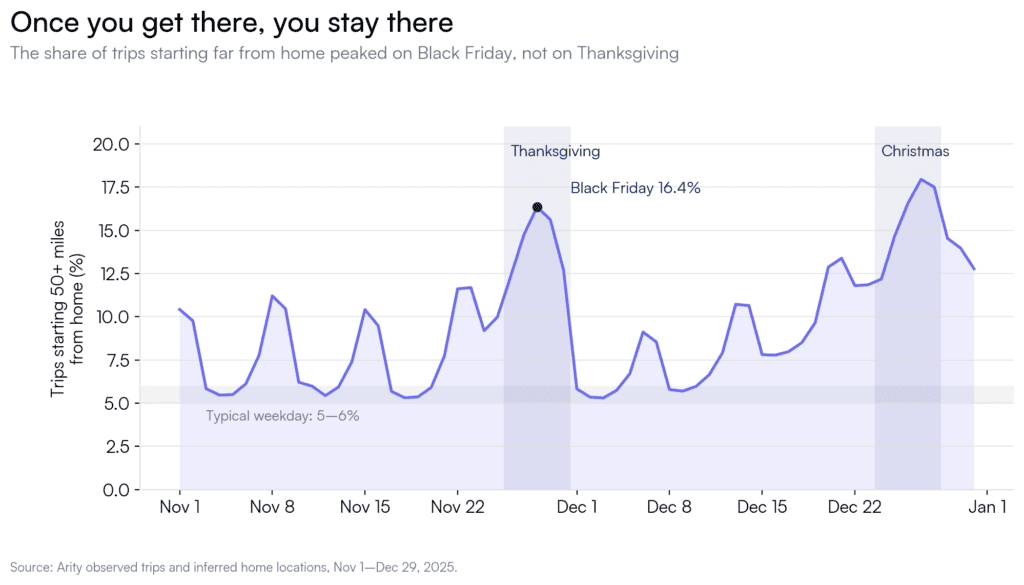
Another signal tells the same story: Drivers hit the road earlier than the Wednesday before Thanksgiving. On an ordinary November weekday, about 5% to 6% of observed trips start more than 50 miles from an inferred home location. That share reached roughly 10% Tuesday, 12% Wednesday and nearly 15% on Thanksgiving itself. The data increasingly show drivers traveling from someplace other than home as Thanksgiving approached.
Sunday showed an especially concentrated return-travel pattern. Sunday, November 30 had more observed trips longer than 50 miles than any other day in November or December. A similar Wednesday-Sunday pattern also appeared in 2024.
Verdict: Strongly supported.
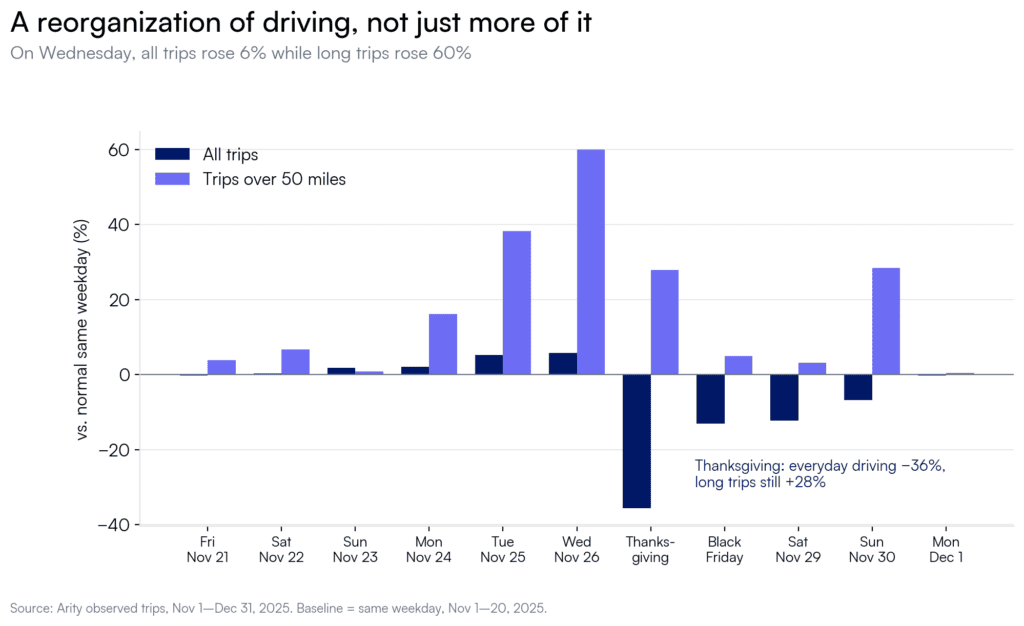
While our data doesn’t tell us the intent of drivers’ movement, it does reveal that drivers, on average, took longer trips compared to preceding weeks in November. Not only that, long-distance driving increased much more than overall trip activity.
On Wednesday, overall trip activity was about 6% above a typical November Wednesday, while trips longer than 50 miles were about 60% higher.
Return trips skewed long as well: Trips longer than 200 miles ran 85% above a normal Sunday, and the average long trip was 114 miles.
That creates an interesting asymmetry: The outbound Thanksgiving trip was spread across several days, while the return trip was more concentrated on Sunday and skewed toward longer distances.
The data cannot tell us whether these travelers’ destinations were Grandma’s house, but they do show that Thanksgiving fundamentally changed the geography of driving.
VERDICT Not exactly, but Wednesday stands out.
According to Arity Road Traffic Analytics, observed grocery visitation built during the days immediately preceding Thanksgiving and reached its highest observed level on Wednesday, November 26. Grocery visits were approximately 27% higher Wednesday than Tuesday and about 39% higher than Monday. On Thanksgiving Day, grocery visitation dropped roughly 57% from Wednesday’s level. The myth of the last-minute grocery run is true.
The larger story is that shopping and travel peaked simultaneously. Wednesday was not merely the busiest pre-holiday day for grocery visits in the Arity Road Traffic Analytics data. It was also the peak outbound travel day relative to its normal weekday baseline.
Gas-station visitation followed a similar pattern. During the Thanksgiving holiday window, Arity Road Traffic Analytics measured its highest gas-station activity on Wednesday, when long-distance mileage surged nearly 80% above a typical Wednesday in November. Similarly, quick-service restaurant visits climbed from Monday through Wednesday before collapsing on Thanksgiving Day.
Across November 21 through December 1, gas-station visits and fast-food visits rose and fell with the number of long-distance trips. That pattern is consistent with what one might guess about the Thanksgiving travel ecosystem: As long-distance driving builds, so do stops to fuel the vehicle – as well as the people inside it.
VERDICT Partly true.
We’re familiar with the idea of Thanksgiving moviegoing, but the truth behind the trope is complex. Although the Thanksgiving weekend boasted impressive box-office debuts across several days, Thanksgiving was a quieter moviegoing day than the days around it.
According to Arity Road Traffic Analytics, observed Thanksgiving Day movie visits were about 62% lower than Wednesday and roughly 64% lower than the preceding Saturday. But moviegoing rebounded quickly: Black Friday visits nearly quadrupled from Thanksgiving and reached their highest observed level within the 11-day window.
The same rebound appeared in restaurants. Full-service restaurant visits rose almost fivefold from Thanksgiving to Black Friday, while fast-food visits more than tripled.
Thanksgiving instead looks like a powerful pause in ordinary out-of-home behavior. Overall trips were roughly 36% below a normal November Thursday, and miles driven fell by about 13%. Despite that, long-distance trips remained about 28% above the typical Thursday level. Many people were still far from home, and some were still traveling, but everyday local movement contracted dramatically. Perhaps the better Thanksgiving cliché is not “go catch a movie while dinner cooks,” but simply “once you get there, stay there.”
VERDICT Yes, and…
If Thanksgiving suppresses out-of-home plans, Friday activates them. According to Arity Road Traffic Analytics, observed big-box visitation on Black Friday was about 39% higher than the previous Friday and reached its highest level during the Thanksgiving window.
But treating Friday purely as a shopping phenomenon misses what else happened. Black Friday was also the strongest day in the Arity Road Traffic Analytics data for movie theaters (up 54% over the prior Friday), full-service restaurants (up 39%), quick-service restaurants, and other restaurant categories. Grocery visitation rebounded from Thanksgiving but remained well below Wednesday’s peak.
Black Friday wasn’t only a shopping rebound; it was a broader return to out-of-home activity.
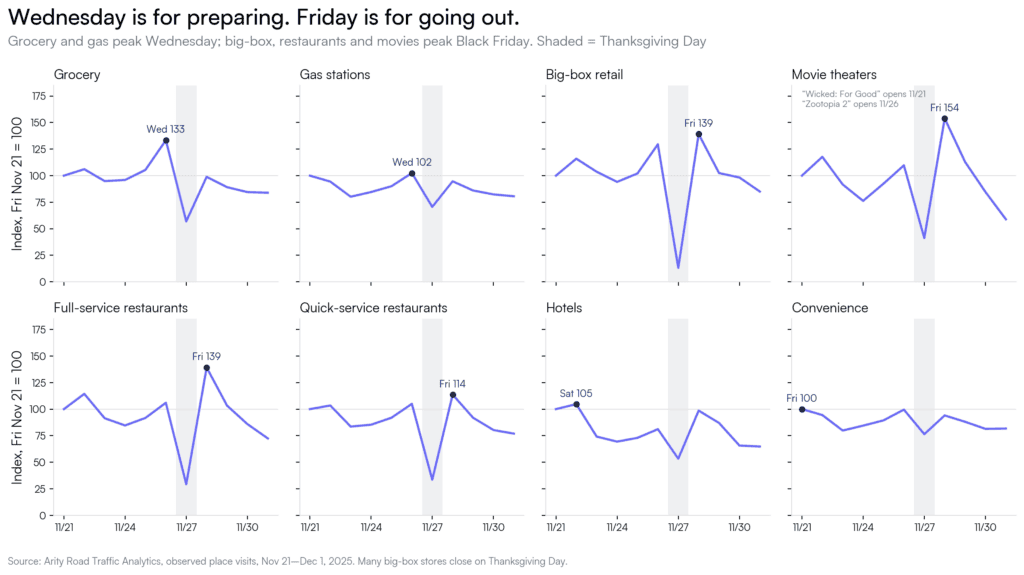
So are the Thanksgiving myths true? Yes and no. Wednesday is indeed a major driving day, but the buildup begins earlier. Sunday stands out as a concentrated day of long-distance driving, suggesting trips back home. Wednesday leads observed grocery activity as many would expect, while Black Friday brings a broader rebound in shopping, restaurants and entertainment.
The Thanksgiving driving story doesn’t quite have the spikes one would expect. Rather, it’s an ebb and flow of different driving patterns as people shift their travel and consumer behavior patterns.
This analysis uses aggregated trips observed by Arity and observed place visits from Arity Road Traffic Analytics (RTA). Trip volumes represent observed trips, not unique people. Home-distance measures are based on Arity’s inferred home locations, and place visits indicate observed visitation rather than a person’s reason for visiting. Where non-holiday baselines are cited, Thanksgiving-period trip activity is compared with the same day of the week during earlier, non-holiday November observations to reduce normal weekday and weekend effects. The visit dataset covers November 21 through December 1, 2025, so place-visit comparisons are within the Thanksgiving window rather than against a full two-month visitation baseline. Correlations describe co-movement and should not be interpreted as proof of causation or person-level trip chains.