A more complete view of mobility starts with understanding people Read article

Transportation operates as a single system.
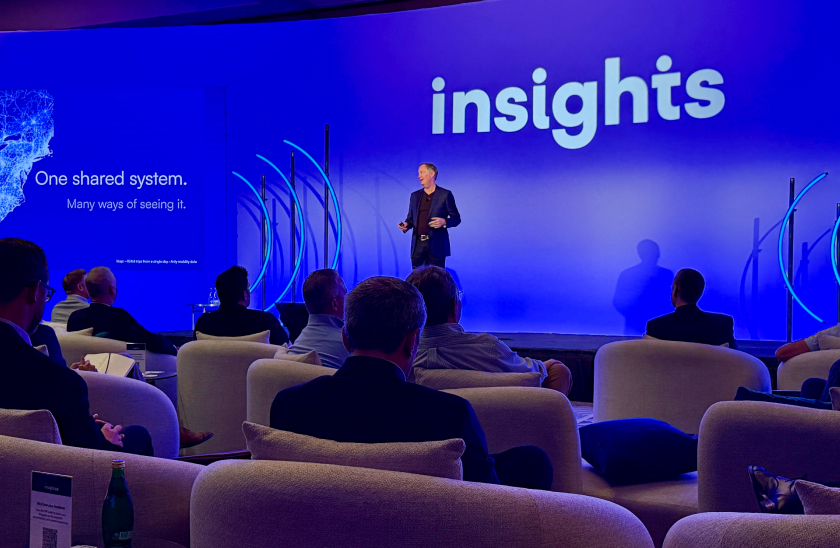
But the intelligence used to understand it is still fragmented across industries, organizations, and data sources. At Arity Insights, our annual conference, leaders who don’t usually find themselves in the same room compared notes on the same transportation system: insurers thinking about risk, retailers thinking about demand, transportation leaders thinking about safety and infrastructure, and technology companies thinking about what happens next.
A common thread emerged across the two days: The value of mobility data grows as organizations connect signals, add context, turn that context into intelligence, and use what they learn to make better decisions, anticipate change, and act sooner.
One of the most interesting takeaways? For a room full of people talking about data, when attendees were asked what was standing between information and action, very few thought more data was the answer. More often, they cited issues with culture, leadership, systems, priorities, and trust.
Across those conversations, a few ideas kept surfacing about what it takes to turn mobility data into meaningful impact.
Context turns data into stories. Gary Hallgren, Arity President, demonstrated this by exploring the potential impact of a new practice facility for the Arizona Cardinals. To the city, it raises questions about road design and safety. To an insurer, it can mean changing risk. To a retailer, a new facility may lead to changing access and demand. To a delivery company, routes and operations could be affected.
Nick Bowden, Replica CEO, shared a similar idea when he examined the cost of a bad road. He described how one road can simultaneously affect safety, vehicle costs, travel reliability, and equity.
In both Gary’s and Nick’s talks, the signal is the same, but the context around that signal changes what it means. Connecting those perspectives is what turns an isolated signal into intelligence that can inform a decision.
If everyone has access to data and technology tools, then having more data and more tools is no longer enough. The differentiation comes from whether an organization can learn and act – and how quickly they can do so.
That idea surfaced repeatedly at Insights. Stacey Brown, in his talk “Speed is the new oil,” described an organization’s culture as the “ultimate refinery.” The competitive edge comes not from having the data, but from understanding it, using it to support the decision-making process, and acting on it quickly. Keith Toney approached the same idea from another angle: the idea of organizational “gravity,” created by systems, incentives, culture, leadership, and processes, influencing the ability to act on mobility intelligence.
These speakers challenged a familiar assumption: that once better intelligence exists, better decisions will naturally follow. Organizations need to reflect on how their internal culture may be helping or hindering the flow of mobility intelligence as part of the decision-making process.
Arity and Experian demonstrate what this can look like in the insurance sector. By bringing mobility intelligence into the insurance shopping experience, consumers can choose to use their existing Arity® Driving Score with carriers at time of quote. Instead of waiting months for a more traditional telematics report to influence pricing, the intelligence can become an input when the decision is actually being made.
Another Arity insurance partner described what an effective learning loop can look like. When an initial implementation didn’t produce the results the team expected, they examined the process, identified changes, and adjusted the approach. As credible loss data came in, the new results validated the value of the driving intelligence and created momentum for additional use cases.
Responsible data use, accuracy, consent, transparency, interoperability, and a clear value exchange are prerequisites for making connected data a trusted part of decision-making. But trust isn’t created by safeguards alone. People and organizations also need to understand the value they’re receiving in exchange for sharing or relying on data.
What challenged our thinking at Insights was the idea that trust is an accelerator for innovation – not a constraint. Arity’s Joy Thomas described how when partners trust how data is handled, diligence gets easier, contracts can move faster, and conversations can shift from logistics to opportunities. She also pushed the conversation from consent alone to the idea of collaboration: people need to understand what they are getting in exchange for sharing their data.
That same principle applies at an organizational level. Texas’ annual Top 100 Congested Road Segments report relies on INRIX data to help inform roughly $100 billion in project selection. Over about 15 years, Texas A&M Transportation Institute and INRIX have built the validation, processes, and relationships necessary for that data to become part of an established decision-making system. The INRIX insights have become part of the data infrastructure supporting the report.
The biggest opportunities may emerge when industries stop solving transportation challenges alone. We have an opportunity to connect datasets and public- and private-sector decisionmakers who have historically viewed the same transportation system from different sides. What becomes possible when the same underlying mobility intelligence helps an insurer understand risk, a transportation agency improve safety, a retailer anticipate demand, and a fleet improve operations?
The merger of Arity, Replica, and INRIX combines complementary perspectives on driving behavior, movement, and road performance and broadens the context around any one signal. These new perspectives can help organizations connect how people drive (Arity) and move (Replica) and how roads perform (INRIX). More importantly, connecting those perspectives expands the questions organizations can answer, from understanding what is happening now to anticipating how risk, demand, movement, or road conditions could change next.
We’re already seeing the potential in these connections. Replica described combining bicycle and pedestrian movement estimates with Arity speeding data to identify places where vulnerable road users may face greater risk. With those insights, a city agency can test an intervention, measure whether behavior changes, and use what it learns to make the next decision faster. Bringing INRIX’s perspective on traffic, incidents, and road performance into that picture adds another layer of context for understanding both the problem and the impact of an intervention.
Having more data or bringing new tools on board is no longer an advantage on its own. The next opportunity in mobility intelligence comes from connecting signals and perspectives to see more of the transportation picture, building trust in that intelligence, anticipating what may happen next, and fostering the development of organizations that can learn and act on it quickly.
The conversations are just getting started. We’ll continue to explore these ideas throughout the year, leading up to next year’s Arity Insights. Consider joining us in 2027.